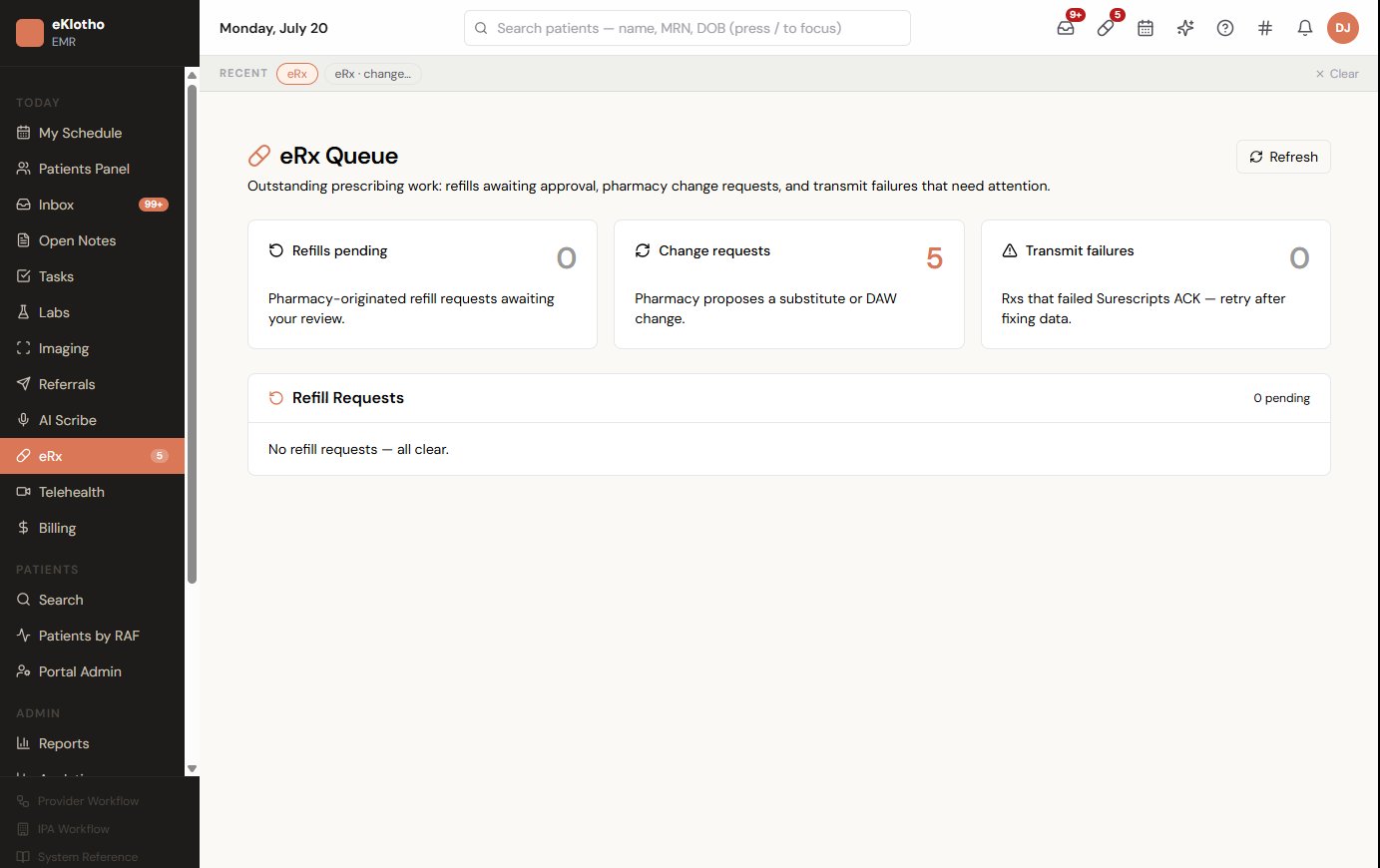
Most EMRs rent prescribing: a vendor iframe opens over the chart, the vendor owns the workflow, and the chart finds out later — if at all — what was prescribed. The eKlotho eRx module inverts that. The chart owns the truth: drug-interaction and allergy checks run against the chart's own medication and allergy lists rather than a vendor's view of the patient, a signed prescription immediately updates the chart's med list, and inbound events — a refill request, a pharmacy's change proposal, a transmission error — are normalized into queues that look the same regardless of which vendor sent them. The vendor is reduced to what it should be: a certified transmission channel behind one gateway interface.
That gateway is the module's architectural core. Each practice configures its own vendor — DoseSpot over REST or Photon Health over GraphQL — with credentials encrypted per organization; the prescribing screens never change when the vendor does. Every prescription records which vendor carried it, so a cancel or a refill response reaches the right channel even after a practice switches vendors. And when no vendor is configured at all, the platform degrades honestly: a signed prescription lands in a QUEUED status instead of TRANSMITTED, the transmit timestamp stays empty, and the record never claims more than what actually happened — the same graceful-degradation pattern eKlotho applies to every optional integration.
Prescribing safety is enforced at signature, in a fixed order: allergy match, contraindicated-interaction block, quantity ceiling parsed from the sig, and a pediatric age floor — each override-able only with a recorded reason, each override audited. Controlled substances get their own rulebook: schedule classification against a curated catalog, zero refills for Schedule II, a hard block when the prescriber has no active DEA registration, and an append-only controlled-substance log that snapshots the DEA number at signing time and cannot be edited afterwards.